Lhotse stands at 8,516m, making it the fourth-highest mountain in the world. It is situated at the border of Tibet and Nepal. Its long east crest is located immediately south of Mount Everest, and the South Col, a vertical ridge that never drops below 8000m, connects the summits of the two mountains. Lhotse has three summits: Lhotse Main (8,516m), Lhotse Shar (8,383m) and Lhotse Middle or East (8,413m). Sometimes, mistakenly, Lhotse has been identified as the south peak of the Everest massif. No serious attention was given to Lhotse until Everest had finally been ascended.
Lhotse was first climbed in 1956 as an alternative route towards the summit of Everest. Ernst Reiss and Fritz Luchsinger, who were part of a Swiss expedition, first climbed Main Lhotse in 1956. Sepp Mayerl and Rolf Walter first climbed Lhotse on December 5, 1979, by taking the SE-ridge.
A deep scar, an icy gully known as the Lhotse Couloir, marks the west face of Lhotse. The couloir is the crucial test of the Lhotse climb mainly because the climbing conditions of the couloir are affected by the weather and seasonal fall. The route progresses through the Khumbu icefall. Though it is often seen as a minor eight-thousander, Lhotse is a dramatic peak in its own right, due to the tremendous south face which rises 3.2 km in only 2.25 km of horizontal distance, making it the steepest face of this size in the world.
The Lhotse Expedition with Himalaya Sacred Trek and Expedition is designed for highly experienced climbers. Participants must have excellent high-altitude climbing skills, strong physical conditioning, and prior experience with technical ice and snow routes. The minimum group size is 3-4 climbers, and the maximum is 15, ensuring proper coordination and safety.
The best seasons to climb Lhotse are Spring (March-May) and Autumn (September-November), when weather conditions are generally stable, offering the best window for summit success. With expert Sherpa support, structured acclimatization, and meticulous expedition planning, Himalaya Sacred Trek and Expedition provides a professionally guided and safe Lhotse experience for elite mountaineers seeking one of the most demanding and iconic climbs in the world.
Highlight of the Lhotse Expedition:
Departure Location: Kathmandu
Return Location: Kathmandu
Namaste and Heartily welcome to Nepal. Our company representatives welcome you warmly at the International Airport of Kathmandu and transfer you to the hotel. You take your rest and enjoy your meal in the evening. Also, the trekking guide would do a briefing or explain to you about the trek. Overnight at the hotel.
On the second day, you will be given an opportunity to make final preparations for your trip. You will also be given an elaborate checklist of materials and gear that you need to make sure that you possess before taking off. We will be briefing you regarding the details of the upcoming expedition and the roles and responsibilities of each team member. You will also get introduced to fellow expedition members and guides.
After lunch, we drove to Manthali airport, which is located in Ramechhap district, so it is also known as Ramechhap airport, as it faces attractive views of Kathmandu and Manthali. During the trekking season, flights operate via Ramechhap, while in the off-season, direct flights from Kathmandu to Lukla are available. After reaching Manthali, we will stay overnight in a lodge at Manthali.
Early in the morning, we fly from Manthali to Lukla, experiencing incredible and beautiful views of Manthali and Lukla. After reaching Lukla, we start to trek to a ridge at 2,800m, before a gradual ascent to the final ridge from where we descend to Surke, following the path toward Phakding. You will trek on the trail cut deep into the steep rocky side of the valley, where you can come across mule caravans making their way alongside you.
At the end, the trekking trail joins back onto the Dudh Koshi River valley, and you can see amazing views of the ebbing river below as you stand high above on the steep side of the impenetrable valley. Overnight at a guest house or lodge.
After Breakfast at Phakding, we will pass through the famous Namche Bazaar, where altitude gains as the walk progresses morning walk starts following the river and crossing several times to reach Monjo village near Sagarmatha National Park entrance. From here, walk through the river valley and gorge, covered with woodland of tall rhododendrons, pines and fir trees. After a few hours, we will reach Namche Bazaar, an ideal place for a rest day to acclimatise, the main town/ village of Khumbu, where a colourful and exciting Saturday market takes place once a week. Overnight at a lodge.
After breakfast, we will go to the viewpoint, just behind the back of Sagarmatha National Park headquarters. The panoramic views of the Everest Himalayan chain, Mt.Everest, Lhotse, Nuptse, Ama Dablam, Thamserku and many more. Then we walk down to the Sherpa Cultural Centre where we can observe the gallery and the documentary of Sherpa’s ascending Mt.Everest. We hike up to Everest View Hotel via Syangboche airport, have a cup of tea and trek to Khyangjuma, where we can see many wonderful mountains as well as not so much crowd, a peaceful place to stay. Overnight at a lodge.
After breakfast, we start trekking to Tengboche. On the way, mountain goats can be seen. A continual walk through rhododendron forests, we descend for about 45 minutes to the bank of the river, called Phunki Tenga, a small place with few lodges, an ideal place for a refreshing or lunch stop. Then we will climb up to Tengboche through the zig-zag trail. Tengboche is the right place to stay, which is surrounded by white peaks just below the Ama Dablam. Overnight at the lodge.
In the morning, catching super views of high peaks with Mt.Everest, our route descends into forested areas, reaching a metal bridge. We ascend for 30 minutes and reach the gate and enter Pangboche village, this is the last Sherpa permanent village en route to Everest Base Camp. From here, the walk leads to barren and arid country where tree lines drop for small bushes of juniper and dwarf rhododendron. The walk leads uphill into a river gorge and finally opens up into a wide glacial valley on reaching Dingboche, with many good lodges around, facing views of island peaks towards the east. Overnight at a lodge.
Today, you can have another acclimatization day. After breakfast, we will see the beauty of Dingboche village with the peaceful people. Then we will have a gentle hike up to Nagarjun hill for the stunning view of the Himalayas, hills, and small Sherpa villages, about 3 hours from Dingboche. Today we will enjoy the beauty of nature and rest for the next day’s trip.
On this day, we will be walking through the side of the Khumbu glacier above Pheriche with a flat hike after our breakfast in Dingboche. We will feel soft snow and cool wind, with the Khumbu Glacier on this standard route. We will be crossing old memorial stones and see the upper Himalayan nature. We will share our route with other Sherpa people and trekkers who are going on expeditions. After reaching Lobuche, we will prepare for our next excursion trek to Everest Base Camp. Overnight at a lodge.
Today, you have another acclimatization day. After breakfast, we will have a short hike around Lobuche. We will also have technical training sessions with Sherpa guides for preparation for Lobuche Peak, including how to ascend and descend in fixed line, which helps climb both Lobuche and Lhotse.
On this day, we begin by climbing toward Lobuche High Camp. We then conduct final summit preparation, including gear checks, rope practice, and safety briefings with Sherpa guides. Overnight at Lobuche High Camp, resting to prepare for the summit push.
As today is one of the important days of the expedition, we start from early morning around 2-3 AM. After reaching the summit of Lobuche East (6,119m), enjoy breathtaking views of Everest, Lhotse, Makalu, Kanchenjunga, Nuptse, Ama Dablam, Cho Oyu, Pumori, Khumbu Glacier, and many more. We then descend back to Lobuche and stay in a lodge.
After breakfast, we pass through iconic memorials for fallen climbers at Thukla and follow the Khumbu Glacier trail through moraine-strewn terrain to reach Lhotse Base Camp.
These three days are dedicated to rest, acclimatization, and preparation for the upcoming rotation and summit phase. On Day 16, climbers participate in the traditional Puja ceremony, a spiritual ritual conducted by Sherpa monks to seek protection and good fortune for the expedition. These days are crucial to ensure climbers are well-prepared physically, mentally, and technically for the challenges ahead.
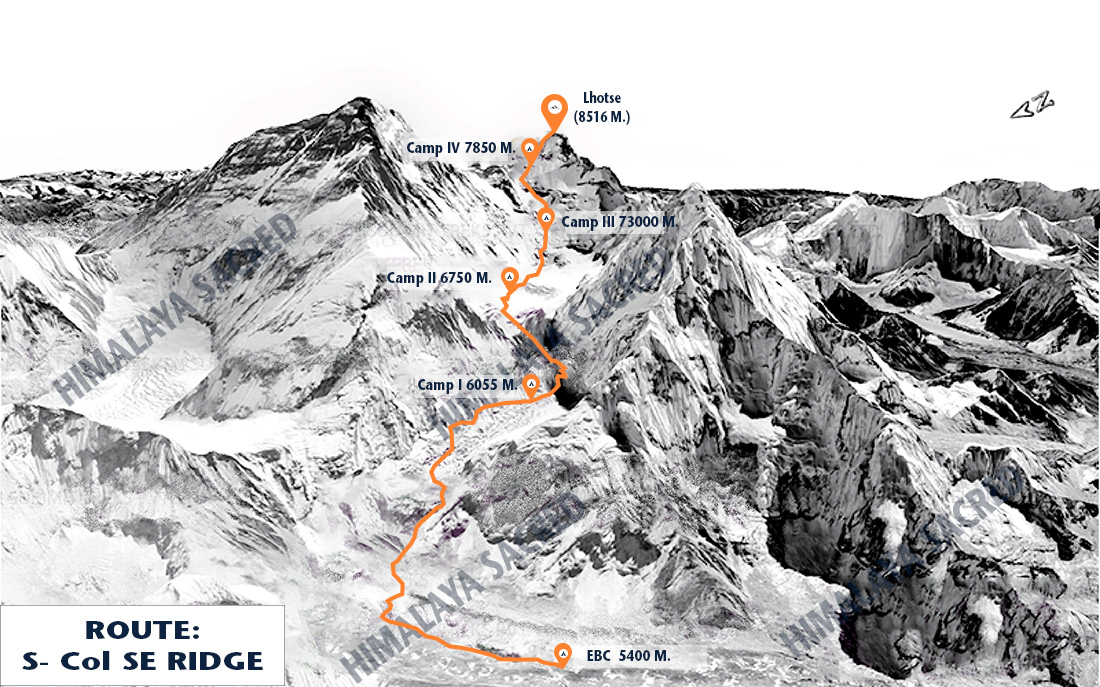
Begin the first acclimatization rotation by leaving Lhotse Base Camp and crossing the Khumbu Icefall under the guidance of experienced Sherpa climbers. Upon arrival, rest, hydrate, acclimatize and have an overnight stay in high-altitude tents shared by two members per tent.
On day two of rotation, we climb to Camp II. Members are provided with hot, nutritious meals prepared by a high-altitude cook. Overnight stay in tents.
We spent a full day resting and acclimatizing at Camp II, allowing our bodies to adapt. Overnight spent in a tent.
On this day, we climb higher up to Camp III. Reaching Camp III, we take time to rest, hydrate, and acclimatize and enjoy the spectacular views of the surrounding peaks. After spending some time in Camp III, we then descend back to Camp II and overnight stay in a tent.
After completing rotation climbs, we descend back to Lhotse Base Camp to rest, recover, and continue acclimatization. Overnight stay in the Base Camp tent.
Now, we spend the next seven days at Lhotse Base Camp resting, acclimatizing, and preparing for the summit push. These days are used for hydration, nutrition, light movement, and maintaining physical readiness while monitoring weather forecasts and assessing the optimal summit window. During this period, if necessary, climbers may descend to Dingboche or lower altitudes to aid acclimatization or recover from fatigue before returning to Base Camp for the summit rotation.
The summit push begins early in the morning, following the route through the Khumbu Icefall. Climbers ascend carefully, passing Camp I along the way, and continue to reach Camp II. Upon arrival, rest, hydrate, and recover, with an overnight stay in tents.
We then spend a full day resting and acclimatizing at Camp II while waiting for the optimal summit window. Overnight stay in tents.
Depart early from Camp II and begin the ascent up to Camp III using fixed ropes. Supplemental oxygen (0.5–1 L/min) is typically used above Camp III during the summit push to maintain safety and performance at extreme altitude and also aid recovery and improve sleep quality at extreme altitude. Overnight spent in tents.
Begin early from Camp III and ascend the final stretch to Camp IV. Overnight is spent in tents.
Begin the final summit push early in the morning from Camp IV, following the iconic route to reach the summit of Mt.Lhotse (8,516m). Climbers are rewarded with breathtaking panoramic views of the Himalaya, including Lhotse, Nuptse, Ama Dablam, and the vast Khumbu Glacier.
After spending time at the summit for photographs and celebration, begin the careful descent back to Camp II, and overnight is spent in tents.
After the summit push, we begin to descend back to Lhotse Base Camp. Overnight is spent in the Base Camp tent.
This day is dedicated to celebrating the successful ascent of Mt. Lhotse with team members, Sherpa guides, and support staff. For those who wish to descend quickly or avoid the trek back, a helicopter transfer can be arranged directly from Base Camp to Lukla and then back to Kathmandu by flight.
Leaving behind the beauty of the Lhotse base camp. We will trek down to Pheriche, which is the place of farming potatoes, buckwheat and keeping yaks. We can see lots of Mani ( prayer stones ), stupas and statues on the way. It is also the place where trekkers take acclimatization day. We will stay here in Pheriche with the stunning view of the Himalayas and hills for the night.
On this day of our trip, we will be exploring Tengboche Gompa after a gentle hike of 4 hours, which is one of the oldest and biggest gompas in the Everest region. We will see various old instruments, old architecture, Mani, Monks’ instruments, and prayer flags. On this day, we can also explore some of the Sherpa villages along with their culture and beautiful lifestyle. After exploring the gompa, we will have a downhill walk in a moderate climate. We will cross the Imja River, Pangboche and walk on a steep path to reach Namche for the night after a trek of about 8 hours.
After having breakfast in Namche, we will slowly move down the steep path crossing the Dudh Koshi river bridge. We will see various small gompas, animals like yaks, prayer flags, and green nature covered with beautiful rhododendron flowers. After walking for a few hours, we will get into some of the villages and on the way, we can see Lukla appearing beautiful and fascinating from a far distance. Then we will finally reach Lukhla and enjoy the success of the trip, which will be our last night in the Himalayas.
Morning transfer to Lukla Tenzing-Hillary airport for a short sweeping flight to Manthali airport located in Ramechhap district, facing scenic views of mountains, green scenery of hills and farm fields with nice villages and towns as the flight lands at Manthali airport and drives back to Kathmandu.
After the long, exhausting trek, you might have worn out a bit. Today, you can do some relaxation activities or just take some rest and connect with your friends and family back home. You can also just wander down the lively streets of Thamel and Asan and buy some souvenirs. In the evening, your tour officer will pick you up for dinner at one of the cultural restaurants of Thamel. After the dinner, you will be escorted back to your hotel.
Your adventure in Nepal comes to an end today! We will take you to the airport, approximately 3 hours before your scheduled flight. On your way home, you will have plenty of time to plan your next adventure in the wonderful country of Nepal.
Complementaries
| Date | Status | Group Size | Action |
|---|---|---|---|
|
56 Days
Start – 2026-04-25
End – 2026-06-03
|
Booking Open | 1 – 12 PAX |